关于金属磁记忆检测法
传统的无损检测方法和手段(超声波检测、磁粉检测、X射线检测)旨在检测已形成的缺陷,且根据其名称无法预防设备的突发疲劳损伤,而这些损伤是设备故障的主要原因,也是大多数导致受伤事故的根源。
众所周知,应力集中(SC)区是运行结构中损伤发生的主要来源,腐蚀、疲劳和蠕变过程在这些区域最为集中。因此,检测应力集中区是设备和结构检测中最重要的任务之一。
应力腐蚀区(SC zones)金属性能的变化(腐蚀、疲劳、蠕变)是设备损坏的前置过程。反映管道、设备和结构实际应力-应变状态的金属磁化会相应地发生变化。
目前,一种基于金属磁记忆(Metal Magnetic Memory,MMM)原理的新型设备和结构的检测方法已经开发出来,并在实践中成功应用。MMM方法结合了无损检测(Non-Destructive Testing,NDT)和断裂力学的潜在优势,因此在工业物体检测方面具有许多显著优势,优于其他方法。
与现有的磁性及其他传统无损检测(NDT)方法相比,金属磁记忆检测法的基本应用优势如下:
金属磁记忆检测法无需特殊的磁化设备,因为其利用了设备和结构单元在运行过程中的磁化现象;
在工作载荷作用下,应力集中的位置(这些位置事先是未知的)会在检测过程中被确定;
无需对测试表面进行金属打磨或其他任何处理;
使用小型仪器、自给电源、记录系统和高达32 Mb的存储单元,通过所提出的方法进行检查;
特殊的扫描设备能够在快速控制模式下以100米/小时甚至更高的速度对管道、容器和设备进行检测。
磁记忆(MMM)方法是评估实际应力-应变状态时最实用的无损检测(NDT)方法。因此,对于设备部件的寿命评估而言,应用这种新型诊断方法最为有效。
所提出的基于金属磁记忆应用的检测方法,能够对机组状态进行综合评估,同时考虑金属质量、实际运行条件及其结构特征。
金属磁记忆检测法的主要任务是在检测对象上检测出由应力集中(SC)区域表征的最危险部分和单元。然后,例如在SC区域使用超声波检测(UT),检测出特定缺陷的存在。基于金属磁记忆检测法检测到的最受力单元的校准强度计算,进行设备实际寿命评估。
除此之外,金属磁记忆和相应的检测设备还可以:
对疲劳损伤进行早期诊断,并预测设备可靠性;
记录检测结果,并建立设备状态数据库;
根据新旧零件对损坏的易感性,对其进行快速分级;
以高达1毫米的精度检测测试物体上未来裂纹的位置和扩展方向,并记录已形成的裂纹;
在某些情况下,无需拆除保温层即可对管道和容器进行检测。
所建议的检查方法主要有哪些新内容?
根据对已知磁性方法的分析,得出其应用的必要条件如下。首先,必须使用磁化设备;其次,只有在预先了解控制对象中应力集中和缺陷位置的情况下,才能有效应用已知的磁性方法。此外,通常,已知的磁性检测方法需要进行金属修整和其他准备工作。显而易见,在扩展结构和设备上应用传统的磁性检测方法几乎是不可能的。例如,对现代动力锅炉中长度接近500公里的管系进行特殊磁化的任务是不现实的。由于影响应力集中区(损伤发展的主要来源)形成的工艺、设计和操作因素各不相同,因此无法预先了解每根锅炉管上的应力集中区。
同时,众所周知,在地球磁场中,大多数由铁磁材料制成的金属结构和设备在工作负载的影响下容易发生“自磁化”。
下面这张图展示了磁弹性效应作用的示意图(ΔBr - 残余感应变化;Δσ - 循环载荷变化;Нe - 外部磁场)。如果循环载荷σ作用于结构的某个区域,并且存在外部磁场(例如地球磁场),则该区域会发生残余感应和残余磁化增长。
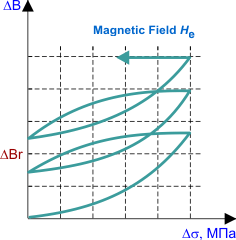
设备和结构“自磁化”现象在各个领域(如造船、电力工程、球轴承等行业)都需加以关注。在以锅炉管为例研究这种磁化现象时,首次有人提出将其用于工程无损检测。在设备和结构“自磁化”过程中,会出现各种磁致伸缩效应。然而,新的检测方法利用的是一种后效(存在于所有类型的磁致伸缩效应中),这种后效表现为金属磁记忆对设备金属中实际应变和结构变化的影响。关于金属磁记忆(MMM)方法与其他已知磁性无损检测方法的主要区别的更详细信息,可参见A. A. 杜波夫的著作《金属磁记忆方法与其他已知磁性无损检测方法的根本区别:方法发展的总结与展望》。
金属磁记忆是一种后效应,表现为产品在弱磁场中制造和冷却过程中形成的金属制品和焊接接头的剩余磁化,或表现为产品在工作载荷引起的应力集中和损伤区域中磁化的不可逆变化。
注:弱磁场指的是地磁场和其他低强度外部场。关于弱磁场和强磁场的更明确界限,可参见Vlasov V.T.和A.A. M.杜波夫所著的《金属磁记忆方法的物理基础》一书,该书由ZAO "TISSO"于2004年出版。
金属磁记忆法是一种基于记录和分析产品表面自漏磁场(SMLF)分布的无损检测方法,用于确定应力集中区、缺陷以及金属和焊接接头结构的不均匀性。
产品的自漏磁场是指在操作应力或残余应力的影响下,或在新产品金属结构不均匀性最大的区域,产品表面位错稳定滑移带区域产生的漏磁场。
对于单个物品、产品和焊接接头,磁记忆检测(MMM)基于对它们在制造和在地球磁场中冷却后,残余应力集中区域产生的自有漏磁场的记录。在任何铁磁产品的制造过程中(熔炼、锻造、热处理和机械处理),真实磁织构的形成机制通常会在冷却凝固的同时,在地球磁场中发生。在晶格缺陷浓度最大区域(例如位错簇)和结构不均匀性区域,域边界以SMLF(自旋磁力线)法向分量符号交替线的形式出现在产品表面。这些线对应于具有最大磁阻的部分截面,并表征了金属结构不均匀性最大区域,因此也表征了内应力最大集中区域(SCZs)。
目前,已有60多份指导文件和检测技术被开发出来,并在电力工程、化工、石化、油气精炼、石油、天然气等工业领域得到实际应用。过去30年间,全球的磁记忆领域的专家学者对金属磁记忆检测法理论验证进行了复杂的研究,开发了定量和定性标准,以便使用金属磁记忆(Metallic Magnetic Memory,简称MMM)方法对设备疲劳损伤进行早期诊断和寿命评估。
金属磁记忆检测方法已在全球1000多家企业得到应用。除中国和俄罗斯外,该方法还在以下44个国家的众多企业中得到实施:安哥拉、阿根廷、澳大利亚、阿塞拜疆、巴林、白俄罗斯、波斯尼亚和黑塞哥维那、巴西、保加利亚、加拿大、哥伦比亚、克罗地亚、捷克共和国、芬兰、德国、匈牙利、印度、伊朗、伊拉克、以色列、意大利、日本、哈萨克斯坦、韩国、拉脱维亚、立陶宛、马其顿、马来西亚、摩尔多瓦、蒙古、黑山、荷兰、阿曼、波兰、罗马尼亚、塞尔维亚、南非、瑞士、塔吉克斯坦、土库曼斯坦、阿联酋、乌克兰和美国。
在我国,以下关于金属磁记忆检测方法的国际标准和国家标准已经指定并生效:
在1994年至2019年期间,共发布了50份关于金属磁记忆方法具有积极结论的国际焊接学会(IIW)文件。
关于金属磁记忆检测法最初的国际标准ISO 24497-1:2007(E)、24497-2:2007(E)、24497-3:2007(E)于2007年获得批准,这是18个国际焊接学会(IIW)成员国和10多个国际标准化组织(ISO)委员会成员国共同投票的结果。
目前,根据国际标准,保加利亚、加拿大、中国、伊朗、意大利、韩国、蒙古、波兰、俄罗斯和乌克兰已实施了金属磁记忆法的国家标准。
凭借在工业和实验室调查方面的丰富经验、可用的技术、指导文件以及科学技术报告,我们得以制定关于金属磁记忆方法、检测设备和人员认证的规范性技术文件(NTD)。除技术和指导文件外,规范性技术文件还包括:对研究金属磁记忆(MMM)方法的专家所需技术知识的要求;一级、二级和三级专家培训计划(经俄罗斯国家工程监督局(Rostechnadzor)批准);检测仪器的通行证和技术规范;操作手册、检测仪器校准和测试技术;结果计算机处理软件的用户手册;培训手册。
关于金属磁记忆检测方法的文章:
A.A. Dubov. The metal magnetic memory method
A.A. Dubov. Purpose and practical capabilities of the metal magnetic memory method
A.A. Dubov. Metrological aspects in the metal magnetic memory method
A.A. Dubov. Fundamental difference of the metal magnetic memory method from other known magnetic non-destructive testing methods. Totals and prospects of the method development
A.A. Dubov. The totals of application of the metal magnetic memory method to industry in Russia and other countries
A.A. Dubov, V.T. Vlasov. On the problem of stress-strain state characteristics measurement of structural materials on complex engineering objects. Energy concept of materials stress-strained state (SSS) diagnostics
A.A. Dubov, Al.A. Dubov. Problems of oil and gas pipelines' stress-strain state control and their solution using the metal magnetic memory
A.A. Dubov. Stress-strain state control of gas pipelines during assessment of their lifetime
A.A. Dubov. Process pipelines inspection without insulation removal using scanning devices and the metal magnetic memory method
A.A. Dubov, Al.A. Dubov. Non-contact magnetometric diagnostics of pipelines and perspectives of its development
A.A. Dubov. Technical diagnostics and monitoring the condition of equipment and structures at the present stage of development
A.A. Dubov. Problems of ageing equipment residual life assessment
A.A. Dubov. Assessment of equipment lifetime using the metal magnetic memory method
A.A. Dubov. Metal magnetic memory method and its capabilities for diagnostics of power boiler elements
A.A. Dubov. Detection of local stress concentration zones in engineering products - the lacking link in the non-destructive testing system
V.M. Matunin, A.A. Dubov, Al.A. Dubov. Determination of metal's mechanical properties by hardness parameters in stress concentration zones detected in engineering products using the metal magnetic memory method
N.A. Makhutov, A.A. Dubov, A.S. Denisov. Study of static and cyclic strains using the metal magnetic memory method
A.A. Dubov, N.A. Semashko, V.Yu. Privalov, L.R. Botvina, A.B. Tsepelev. On relationship of magnetic, acoustic and mechanical characteristics assessed during tensile testing of steel specimens
A.A. Dubov, Al.A. Dubov. Capabilities of the metal magnetic memory method for monitoring of cracks development
A.A. Dubov, S.M. Kolokolnikov. Review of welding problems and allied processes and their solving using metal magnetic memory effect
A.A. Dubov, Al.A. Dubov, A.A. Sobranin. Diagnostics of oil-production drilling rig units and components using the metal magnetic memory method
A.A. Dubov. Reliability assurance of oil production facilities electric submersible centrifugal pump parts using the metal magnetic memory
A.A. Dubov. Quality control of cast valves using the metal magnetic memory
A.A. Dubov, S.M. Kolokolnikov, A.G. Medvedev, D.S. Boriskin. Integrated testing of liquid ammonia refrigerator tank welded joints
A.A. Dubov. New requirements to methods and tools for diagnostics of materials stress-strain state
Basic publications:
1. Dubov A.A., Dubov Al.A., Kolokolnikov S.M. Method of metal magnetic memory and inspection instruments. Training handbook. Moscow: Publishing House "Spektr", 2012.
2. Vlasov V.T., Dubov A.A. Physical theory of the "strain-failure" process. Part I. Physical criteria of metals limiting states. Moscow: Publishing House "Spektr", 2013. 488 p.
3. Vlasov V.T., Dubov A.A. Physical theory of the "strain-failure" process. Part II. Process thermodynamics. Moscow: Publishing House "Spektr", 2016. 223 p.
4. Vlasov V.T., Dubov A.A. Physical bases of the metal magnetic memory method - 2-nd ed. Moscow: Publishing House "Spektr", 2019. 394 p.
5. Dubov A.A. Metal magnetic memory method. History of origin and development. Moscow: FSUE "Izvestiya" Publishing House, 2011.
6. Dubov A.A. I.C. 2029263. Patent of Russia and the C.I.S. countries. Method for residual stresses determination in products made of ferromagnetic materials. List of Inventions, No.5, 1995.
7. Proceedings of the First, the Second, the Third, the Fourth, the Fifth, the Sixth, the Seventh and the Eighth International Scientific-Technical Conferences "Equipment and structures diagnostics using the metal magnetic memory". Papers and summary to papers. Moscow: Energodiagnostika Co. Ltd, 1999, 2001, 2003, 2007, 2009, 2011, 2013, 2015.
8. Dubov A.A. Diagnostics of boiler tubes using the metal magnetic memory. Moscow: Energoatomizdat, 1995.
9. Dubov A.A. Diagnostics of turbine equipment using the metal magnetic memory. Moscow: ZAO "TISSO", 2009.
10. Dubov A.A. Diagnostics of pipelines, equipment and structures using the metal magnetic memory. Collection of papers and reports. Moscow: Energodiagnostika Co. Ltd, 2001.
11. Dubov A.A. Investigation of metal properties using the magnetic memory method // Physical metallurgy and thermal treatment of metals, No.9, 1997.
12. Dubov A.A. Express method of welding stresses inspection // Welding fabrication, No.11, 1996.
13. Dubov A.A. Diagnostics of rails fatigue damaging using the metal magnetic memory // In the world of NDT, No.5, 1999.
14. Goritzky V.M., Dubov A.A., Demin E.A. Investigation of steel samples structural damaging using the metal magnetic memory method // Testing. Diagnostics, No.7, 2000.
15. Dubov A.A. The problems of the ageing equipment life assessment // Labour safety in industry, No.12, 2002, pp.30-38.
16. Dubov A.A. The method of metal limiting state determining and equipment life assessment by magnetic diagnostic parameters // Testing. Diagnostics, No.5, 2003.